
How much does a house extension cost?
This tends to be the 1st question clients ask us, and it’s important for us to discuss it from the outset as it’s probably the biggest factor to consider. How much a house extension costs depends on a wide range of factors which we have outlined below.
Background info:
Before we delve into how much a house extension costs, let me give you some background. Building costs during covid saw a massive spike and post covid that spiked continued with the war in Ukraine pushing energy costs up. Most building materials are energy intensive to manufacture.
As a guide pre covid sqm rates for a mid spec extension (new building element) would be between £1500-£1800+vat. Post covid you’re looking at £2750-3300+vat for the same level of specification.
Note that the above only relates to new build elements to an existing property. If it’s a completed new build then you would be zero vat rated (for 99% of things), but not for and this is key, any consultants’ fees. If you want to know more about the zero vat rated exclusions and inclusions take a look here. We also work with specialist tax consultants who can advice on this and apply for the exemptions.
As well as the cost of the new elements to your existing home you need to consider the cost of any internal alterations. For refurbishment works you would now be looking at a range from £1000-£1500+vat per sqm. It’s very hard to give a flat sqm rate for this type of work as the work involved in one room can vary considerably to another.
Factors affecting the build cost:
- Exterior finish e.g. type of brick, render, stone, timber, or zinc.
- Window and doors e.g. aluminium, timber or uPVC, sliding or bi-folding
- Window and door size e.g. bespoke floor-to-ceiling or standard sizes
- Floor finishes e.g. polished concrete, ceramic tiles or engineered wood
- Wall finishes e.g. fair-faced concrete, painted plaster, exposed brick or blockwork.
- Kitchen design/supplier e.g. off the shelf, bespoke, handmade.
- Joinery e.g. bespoke handmade or off the shelf.
- Lighting/electrics/audio visual e.g. whole-house control, smart systems, dimming or simple switching
- Heating e.g. air conditioning, underfloor heating, smart systems or radiators.
- Heating and electricity sources e.g. solar panels, ground or air source heat pumps
- Soil conditions e.g. land may be contaminated, piled foundations may be required or the property is located on a floodplain.
- Construction methodology eg SIPS, non standard techniques.
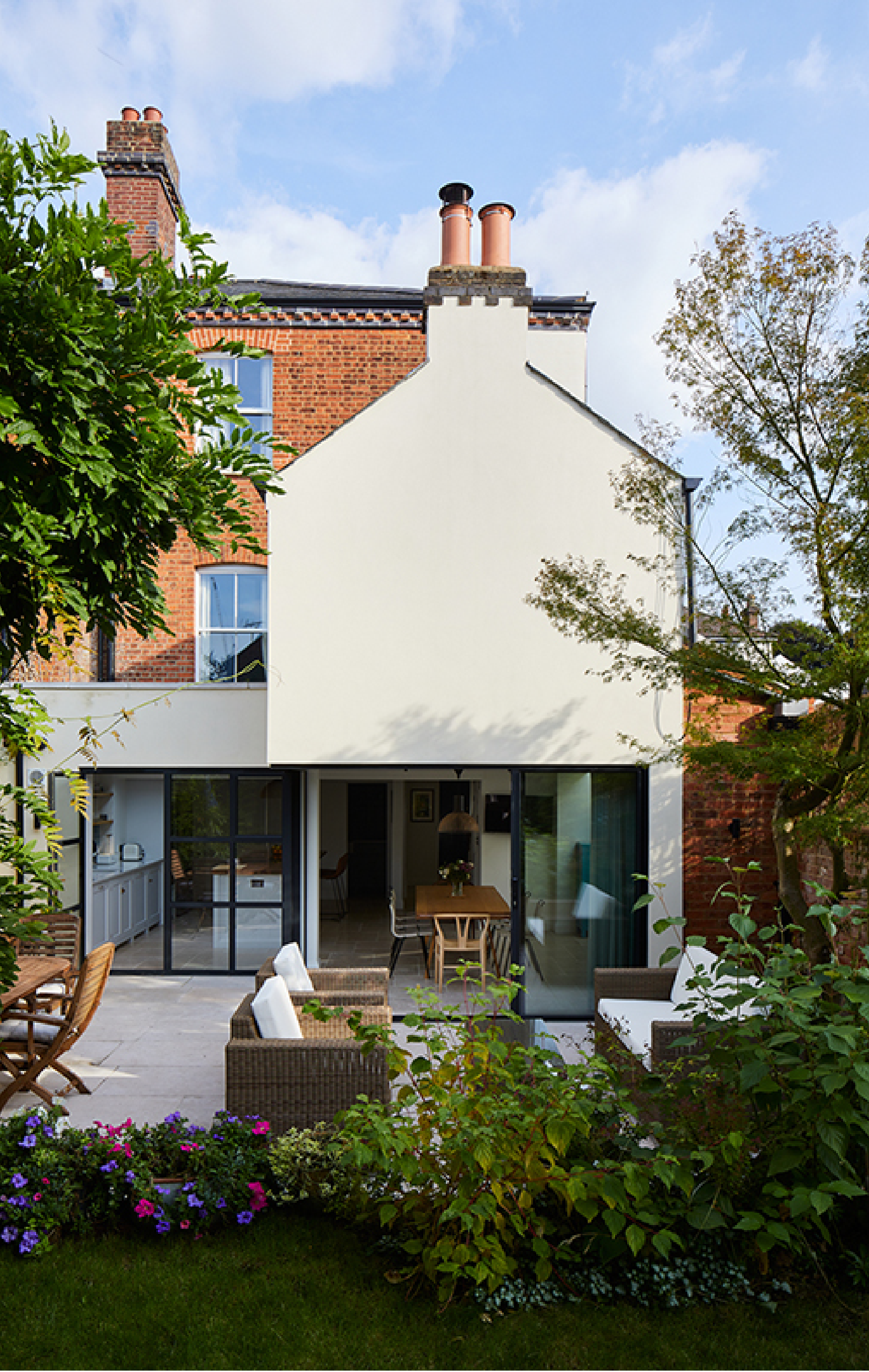

Soil conditions:
You may need to use piled foundations if there are protected trees in close vicinity to protect their roots, or there is contaminated land or you live on a floodplain and the building needs to be elevated off the ground (and for good reason I might add!).
Construction Method:
You may want to use an innovative building material that has top notch sustainability credentials. This would normally come with a premium price tag attached and required specialist contractors to install. Examples would be Passivhaus, EnerPHit or Zero Carbon.
Intricate Design:
You may want to have a copper roof or zinc cladding. These are considered non standard building materials for a house extension so expect to pay a premium and make sure the value of the house will reflect that premium.
Be wary that the cheapest materials may not have the longevity as something slightly more expensive so it is a false economy if you plan to live in the property for more than a few years.
Cost calculator:
If you need some guidance on what the build cost for your home extension or renovation project might be take a look at our cost calculator.

In conclusion, how much your house extension project will cost depends on many factors. Before starting your home extension project, you need to have a firm grasp yourself and with your chosen professional about what your budget is and what the likely build costs would be.
Alot of people might feel uncomfortable talking about their budget for fear of thinking that we’ll end up spending every last penny. This couldn’t be further from the truth.
Knowing what your budget is allows us to start a frank conversation as to whether or not it aligns with what you want to do. It’s all very well having grand designs but if you don’t have the budget to reflect that then we need to either scale down the project brief or you need to find more money.
And it’s far better to have this conversation NOW rather than 6 -9 months down the line when you invested your time and money only to get building quotes that are massively beyond your means.
At Sheldon Peever Studio, we provide comprehensive architectural services to help you bring your dream home to life. The means we don’t just draw up plans and walk away. We provide a holistic approach which includes looking at the often overlooked costs of delivering projects.
Get in touch .
Book a FREE 30 minutes call to discuss bringing your dream home to reality with one of our senior team.
The outcome of that call will be:
- Having answers to your crucial questions.
- A clearer understanding of how to achieve your dream home.
- A 6 stage pathway to success laid out for you to follow.

Dream Home Guide
Download your free Dream Home Guide for all our best tips and tricks on how to build your dream home.
Here you will find answers to some of the most commonly asked questions and the answers to them.